
David LeBoeuf, LNCMI-Grenoble, and Cyril Proust, LNCMI-Toulouse
Strange metals – which exhibit unusual properties such as a resistivity that scales linearly with temperature – challenge our understanding of charge transport in metals. A general and puzzling feature of a strange metal is a linear-in-temperature resistivity existing over a wide region of the phase diagram in the limit of low temperatures. In contrast, a linear resistivity down to the lowest temperature is observed in quantum critical metals, but only at a singular parameter in the phase diagram. A common ingredient for theories of strange metals is often the existence of a low-energy degree of freedom that can effectively couple to charge carriers down to the lowest temperature. In high-Tc cuprate superconductors, the nature and origin of these low-lying excitations remains elusive.
We used fields as high as 86 T to explore the physics of strange metals in the cuprate superconductor La2-xSrxCuO4 (LSCO). Close to the critical hole-doping concentration of the pseudogap p = 0.19, we discovered that a temperature-linear resistivity exists down to the lowest temperature over an extended range of magnetic fields, between 60 and 70 T or so, and disappears above (see figure 1a). Indeed, above 70 T, a spin-glass phase gradually appears, as demonstrated previously using ultrasound measurements, and causes the end of strange metallicity, as outlined schematically in the phase diagram of figure 1b. In the region where low-temperature magnetic fluctuations exist, as proven by previous NMR and ultrasound measurements, a linear-in-temperature resistivity appears over an extended range of magnetic field (green area in figure 1b). Thus, the strange metal can be controlled with a field, via spin dynamics, and the strange metal phase is closely linked to low-energy magnetic fluctuations that persist at the lowest temperatures.
Our results show that the field-dependent magnetism drives the magnetoresistance, a mechanism which had been completely overlooked so far. Resistivity upturns, a signature of a metal-insulator crossover of LSCO, appear at low temperatures in the spin-glass phase. This demonstrates that the metal-insulator crossover is linked to the freezing of spins, which elucidate a long-standing mystery of cuprate superconductors.
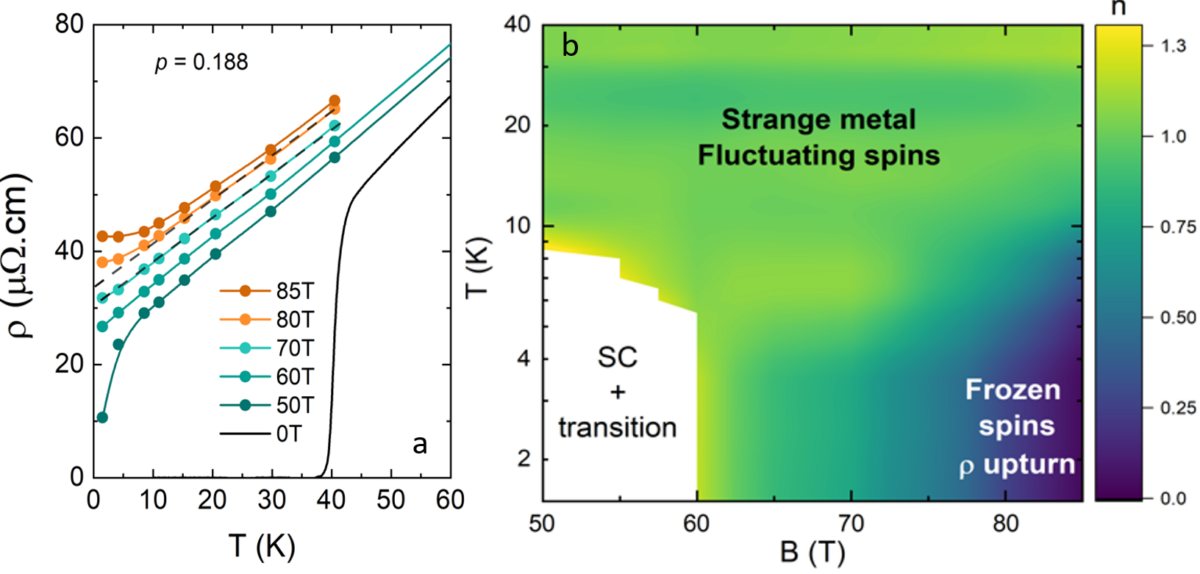
Figure: a) Resistivity of LSCO with hole concentration p = 0.188, near the pseudogap critical doping, as a function of temperature at various magnetic fields. Dashed lines are fits to the data. b) False-color plot of the exponent n of the temperature-dependent in-plane resistivity ρ(T) = ρ0 + aTn. It is obtained from interpolation of (dln(ρ(T)-ρ0)/dlnT) calculated for different magnetic fields. The white area corresponds to the superconducting phase and the resistive transition. ρ0 is the residual resistivity extrapolated to T = 0 from linear fits as shown in panel a.
Impact of low-energy spin fluctuations on the strange metal in a cuprate superconductor, D. J. Campbell, M. Frachet, V. Oliviero, T. Kurosawa, N. Momono, M. Oda, J. Chang, D. Vignolles, C. Proust, and D. LeBoeuf, Nat. Phys. (2025).
Contact: David.leboeuf@lncmi.cnrs.fr